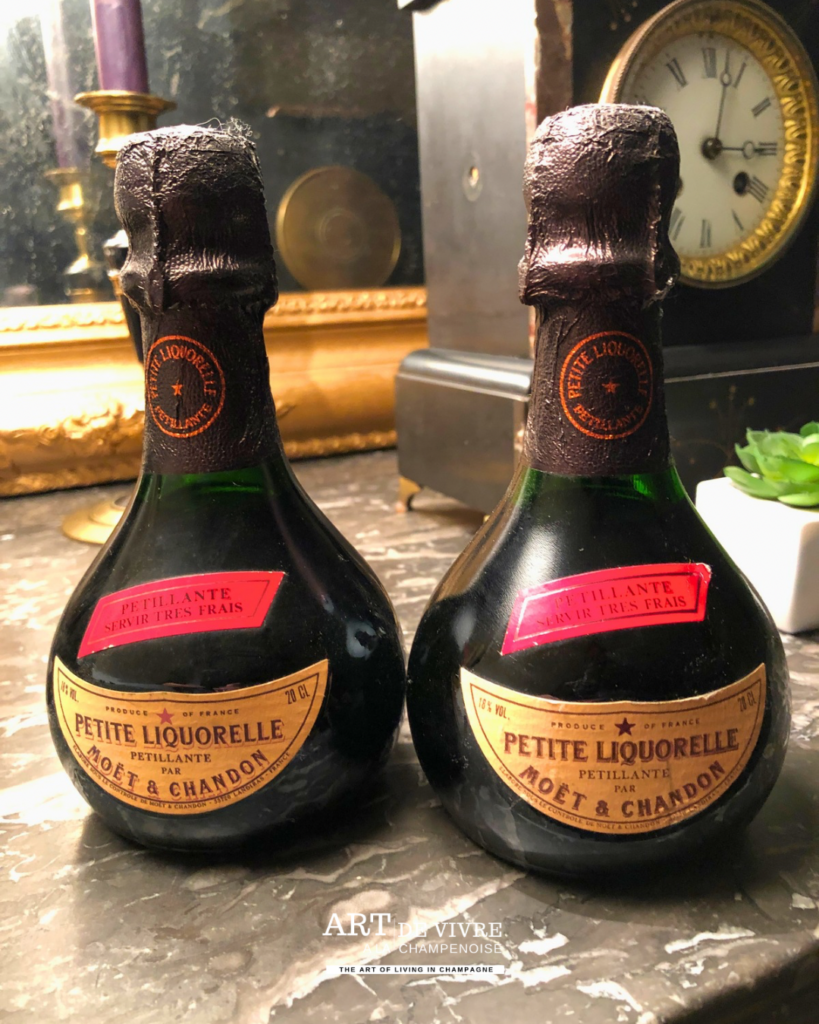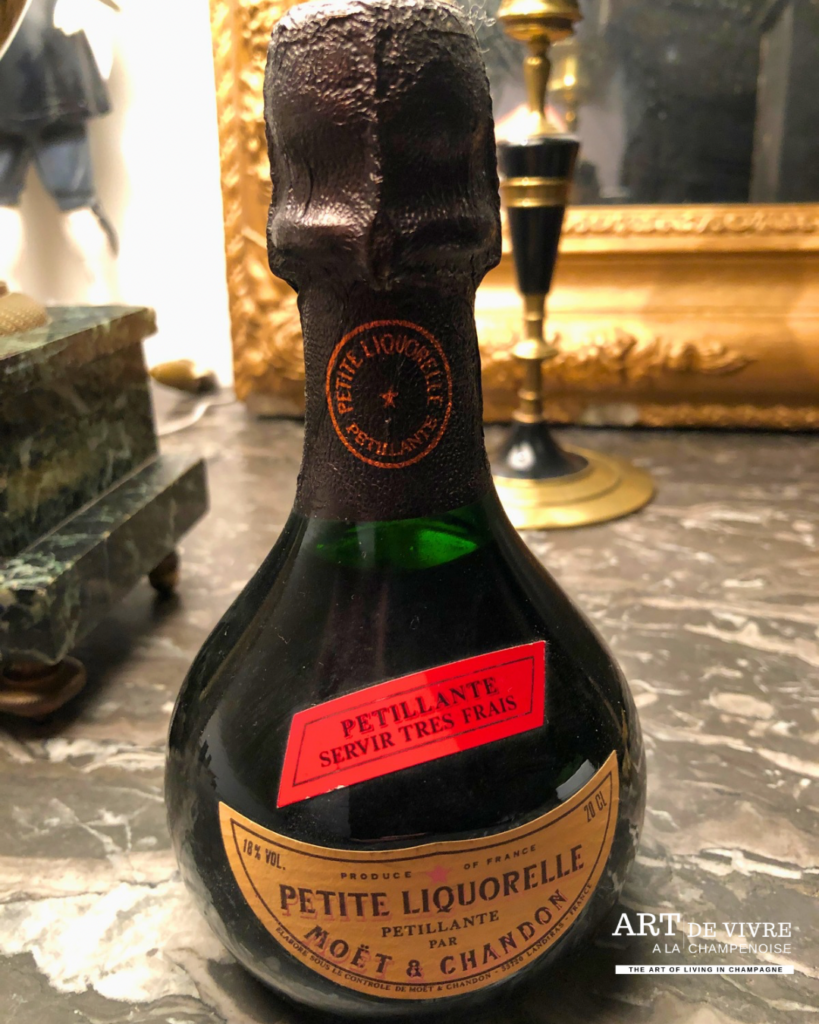

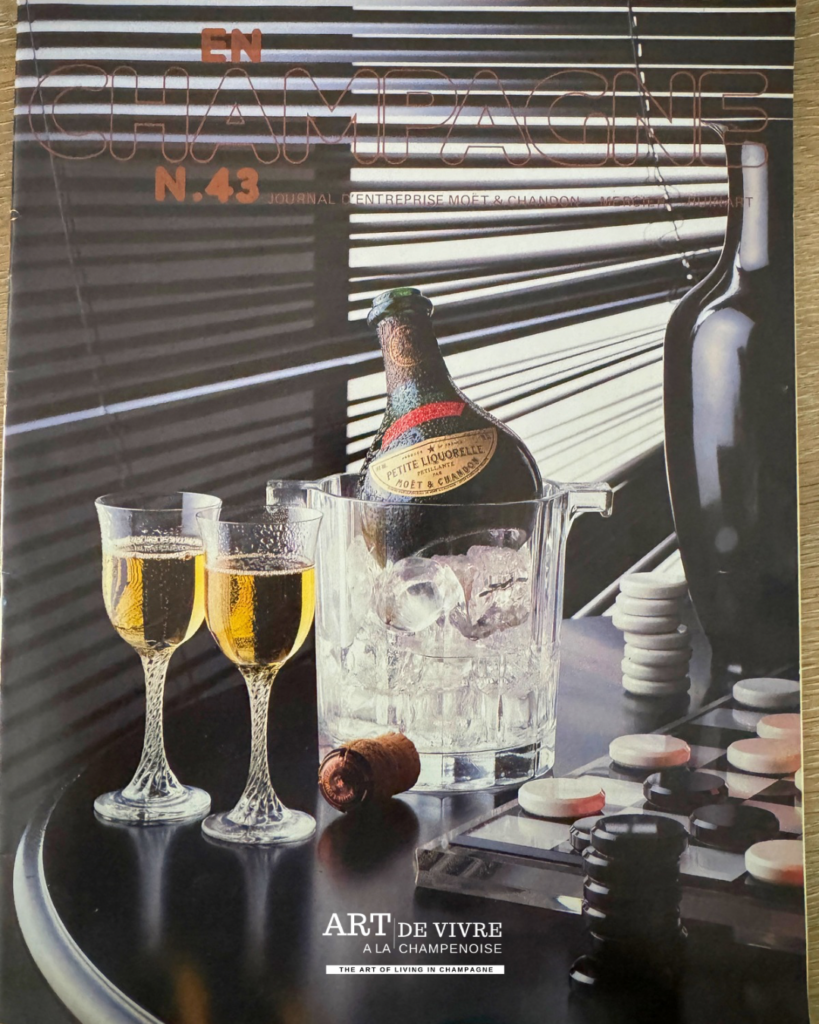
In 1988, the in-house magazine En Champagne devoted a special issue to a singular adventure in the history of Moët & Chandon: the launch of La Petite Liquorelle. It was a product bearing the signature of the Épernay House, but it was not champagne. It was conceived as a sparkling liqueur, inspired by the taste of very old vintages, and meant to open up a new territory of consumption.
Nearly forty years later, this rediscovered archive tells much more than the birth of a bottle. It reveals an era, a strategy, a corporate culture and an attempt at innovation carried out on a large scale by one of the greatest Champagne Houses. With hindsight, the story takes on another dimension: La Petite Liquorelle would not enjoy the success that was hoped for. But its launch remains a textbook case of how Moët & Chandon was then seeking to explore new uses beyond champagne.
An idea born in the 1980s
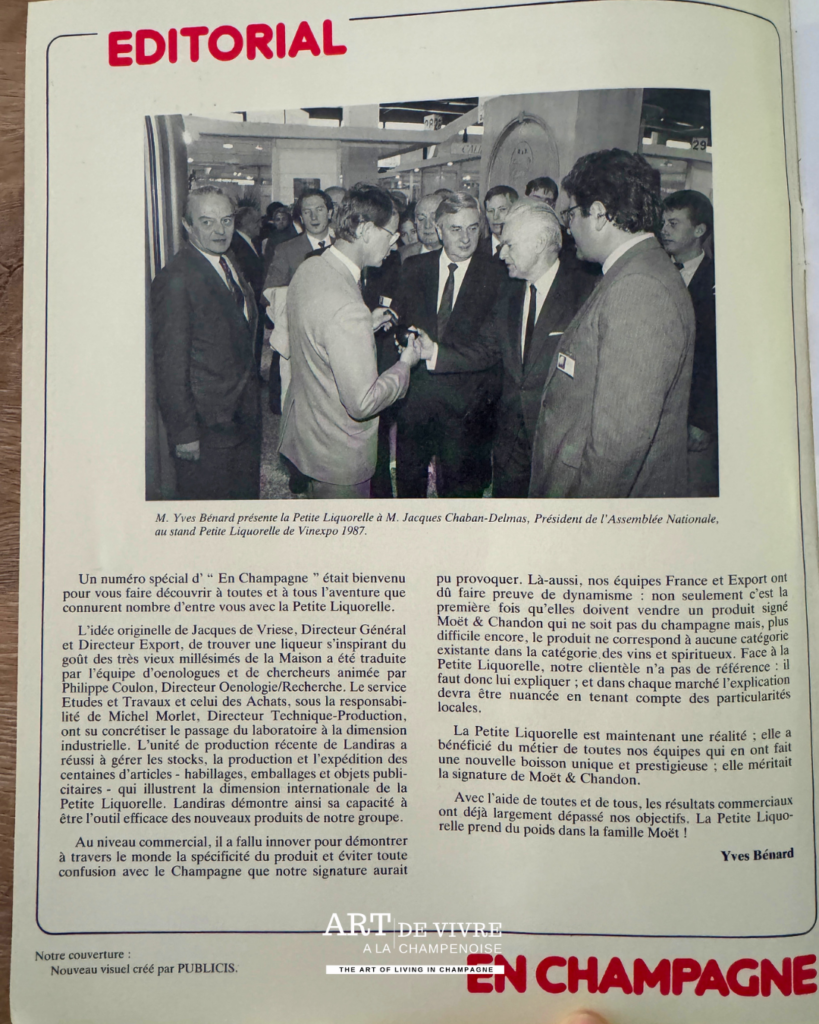
At the origin of La Petite Liquorelle was an intuition from Jacques de Vriese, then General Manager and Export Director. The idea was clear: to create a liqueur inspired by the taste of the House’s very old vintages. In the editorial of the internal magazine, Yves Bénard recalls that this project mobilised the oenology, research, purchasing, production, marketing, export and logistics teams.
The product first received a code name: “Charly”. The formula had to evoke a very old, heavily dosed champagne, almost syrupy, with notes of mocha, coffee, hazelnut or chocolate. The bubbles, for their part, are described in the document as “rather lazy”. The positioning was delicate: La Petite Liquorelle had to extend the Moët & Chandon universe without being mistaken for champagne.
That was the whole difficulty. For the first time, the sales teams had to sell a Moët & Chandon product that did not belong to the champagne category. The document insists on this ambiguity: the customer has no frame of reference. They had to explain, reassure, convince and adapt the pitch to each market.
From the laboratory to Landiras
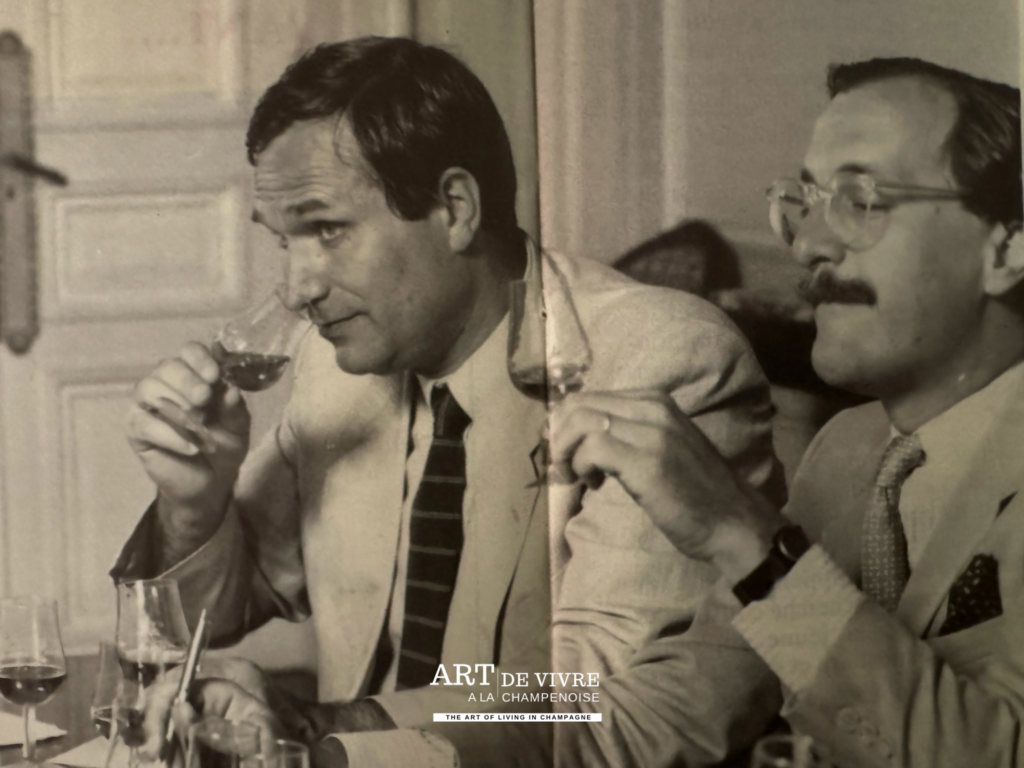
Development was entrusted to the research and oenology teams, notably around Philippe Coulon, Bruno Duteurtre and Monique Charpentier. The latter says she worked on the balance between sugar, alcohol and aromas, with more than a hundred trials recorded in a notebook. The document mentions two years of tastings and adjustments to arrive at the final formula, then several additional months to solve the technical problems linked to production.
Moving from the laboratory to industrial scale was by no means straightforward. The magazine recalls that the product had to be stabilised, its effervescence preserved, the right closure chosen, the pressure managed, transport conditions anticipated and the machines adapted. The stakes were all the higher because Moët & Chandon was not merely launching a drink: it was launching a complete universe, with its bottle, its labels, its ice bucket, its gift boxes, its sales materials and an entire visual identity.
Production was entrusted to the Landiras unit, in Gironde, within Fines Spécialités. The document gives the measure of the industrial ambition: in January 1987, 50,603 bottles were shipped. By the end of December 1987, the figure reached 1.7 million bottles, with the target exceeded. To support the ramp-up, temporary workers were hired and the production line mobilised several dozen people from the region.
The bottle required particular care. Three labels, a foil capsule, an elaborate dress: La Petite Liquorelle claimed a luxurious, almost theatrical presentation. The packaging became an argument in its own right. It is also one of the most visible signs of an era when innovation was as much about the object as about the taste.
A highly organised global strategy
The special issue shows how much the launch was conceived as an international operation. Landiras shipped the bottles, Épernay organised the sales materials, the export teams adapted the messages and local agents became essential relays. The document mentions Bermuda, the Virgin Islands, Barbados, Guadeloupe, Martinique, Puerto Rico, Spain, Belgium, England, Australia and the Nordic markets.
But each country imposed its own constraints. In Latin America, import taxes and licences complicated distribution. In Scandinavia, state monopolies slowed down listings. In Europe, questions of naming and legal protection arose very quickly. Depending on the country, the designation “Petite Liqueur” or “Petite Liquorelle” was accepted differently. The brand had to be protected, defended and sometimes adapted.
The document also highlights a commercial reality that still holds today: an innovative product does not sell on quality alone. It needs a story, influencers, places of consumption and precise uses. La Petite Liquorelle was presented as an after-dinner drink, to be served very chilled, in an intimate or festive setting, often with a dessert.
Influencers to win over
To bring La Petite Liquorelle to life, Moët & Chandon relied on restaurants, hotels, department stores, wine merchants, sommeliers and prestigious venues. The document cites in particular the Royal Champagne in Champillon, the Château de Saran, Fauchon, Hédiard, Harrods in London and a restaurant in Barcelona.
At the Royal Champagne, the product inspired desserts, notably around sabayon. At Saran, it was presented as the “little sister of Moët”. At Fauchon, it was seen as a festive product, suited to gifting, even if the 20 cl size sometimes seemed too limited. In London, customers were intrigued by the shape of the bottle and by the Moët & Chandon signature, but some immediately asked whether it was champagne.
This confusion is at the heart of the story. La Petite Liquorelle benefited from the strength of the Moët & Chandon brand, but that same signature created very high expectations. The container was appealing. The name was reassuring. Yet the contents could surprise, even disconcert. Some consumers found the product too sweet. Others instinctively associated it with champagne, although it contained none.
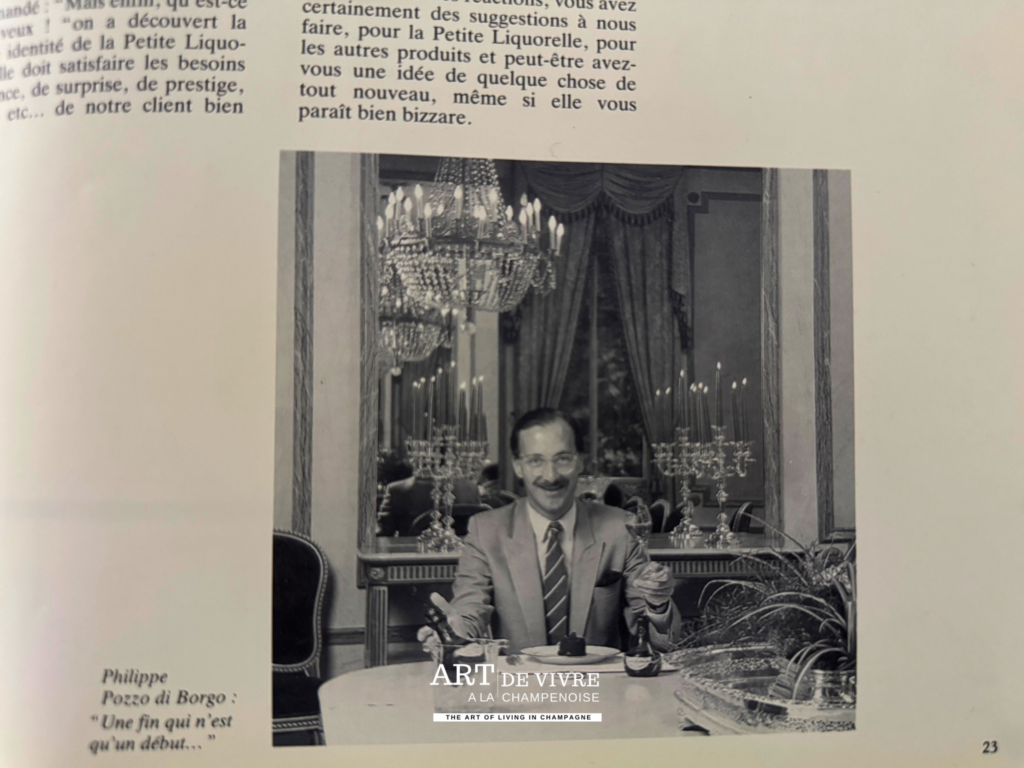
Philippe Pozzo di Borgo, a signature that has become singular
The archive also takes on a particular resonance through the presence of Philippe Pozzo di Borgo. In the document, he appears as coordinator of La Petite Liquorelle and, with Nathalie Liébart, signs the conclusion of the special issue.
Today, his name reads differently. Much later, the accidents of his life would inspire the film Intouchables (The Intouchables), with François Cluzet and Omar Sy, an immense popular success. In this 1988 archive, he is still fully engaged in this professional adventure, at the heart of a project that mobilised the House’s trades, from export to marketing, from production to internal communication.
The conclusion he co-signs is, moreover, very revealing. It insists on one central figure: the consumer. That “somewhat mysterious character” on whom the entire business ultimately depends. The text acknowledges that the classic arguments are not enough. Saying the product is signed Moët & Chandon is not enough. Saying it is a first sparkling liqueur is no more sufficient. One must understand what the customer is really looking for: romance, surprise, prestige, pleasure, trust.
A brilliant innovation, but hard to establish
Reading the document, everything seems to have been in place for success: a great House, an unprecedented product, a remarkable bottle, a collective mobilisation, international distribution and encouraging first figures. Yves Bénard even writes in his editorial that commercial results far exceeded the targets.
But the story of La Petite Liquorelle is a reminder that a good launch does not guarantee lasting success. The product sat in a complex in-between. Too close to the champagne universe to be fully autonomous, too different to be understood spontaneously, too specific to easily enter consumption habits.
This is perhaps where its fate was decided. La Petite Liquorelle needed explanation. Yet the products that endure are often those whose use becomes self-evident. Here, it was necessary to specify the occasion, the service, the temperature, the glass, the pairing, the difference from champagne and the product’s reason for being. This permanent need for explanation probably limited its rollout.
A precious archive on the spirit of innovation
Even though La Petite Liquorelle has not left a large mark on collective memory, this 1988 archive is precious. It shows a House capable of stepping outside its historical territory to test a new category. It also tells of the importance of the invisible trades: those who formulate, test, dress, package, ship, print, legally protect, manage stocks, support the markets and build the narrative.
Through this attempt, Moët & Chandon was not only seeking to sell a different little bottle. The House was seeking to understand how far its signature could go without losing its meaning. La Petite Liquorelle did not follow the hoped-for trajectory, but it remains a fascinating witness to an era when the great Houses were already exploring diversification, experience, the object, the gift and new moments of consumption.
In the archives, some bottles tell of successes. Others tell of experiments, intuitions, bets that never found their audience. La Petite Liquorelle belongs to this second family. And that is precisely what makes it interesting today: it sheds light on the backstage of a Champagne innovation, with its ambitions, its promises, its hesitations and that share of daring that also makes the history of the great Houses.