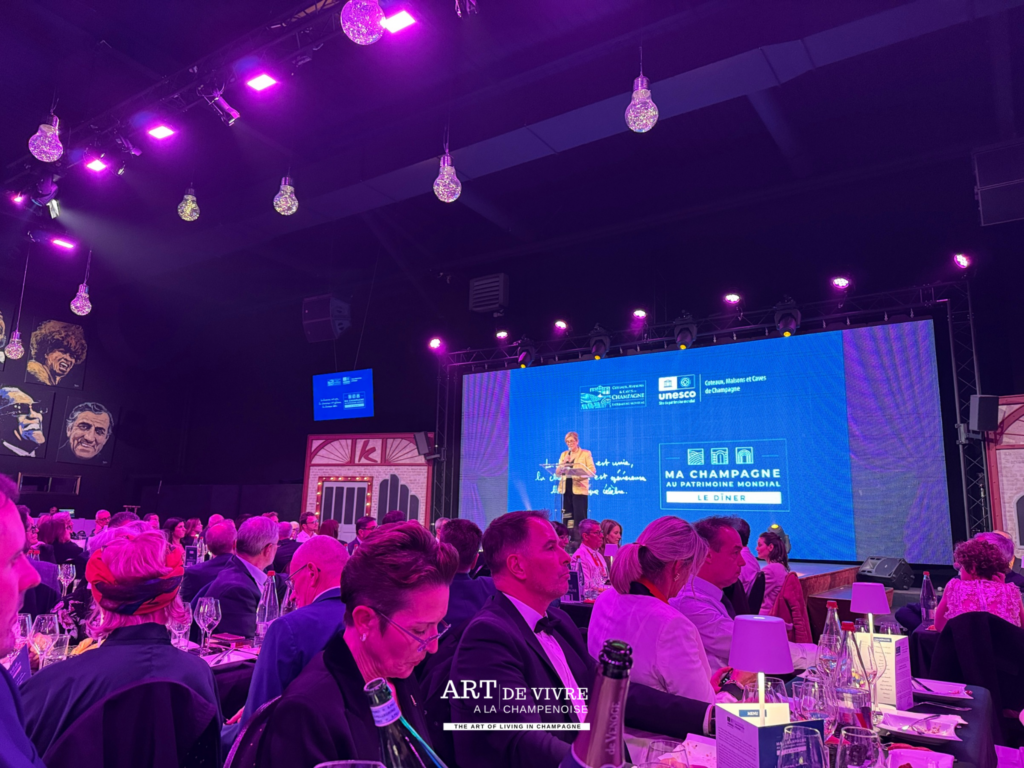

Nearly 450 guests took their seats at the Reims Congress Centre for an exceptional charity dinner celebrating the ten years of the inscription of the Champagne Hillsides, Houses and Cellars on the UNESCO World Heritage list. Placed under the high patronage of the academician Daniel Rondeau, patron of this anniversary, the evening marked the official launch of a fundraising drive dedicated to scientific research on the Champagne cellars, this underground heritage as spectacular as it is still largely unknown.
Preserving the invisible: the CELLARS project
The CELLARS scientific project, led by the Université de Reims Champagne-Ardenne, aims to map, model and better understand these galleries thanks to cutting-edge technologies: lasers, LiDAR, point clouds, multi-dimensional modelling…
While the Champagne landscape fascinates with its hillsides, its monumental crayères and its emblematic houses, the heart of the listed heritage also lies beneath our feet. The cellars form a unique vertical landscape, shaped by generations of builders and winegrowers. This labyrinthine network, which extends over hundreds of kilometres, forms an invisible treasure, essential to the ageing of the wines and to the deep identity of the region.
The CELLARS scientific project, led by the Université de Reims Champagne-Ardenne, aims to map and model these galleries thanks to cutting-edge technologies: laser capture, LiDAR, point clouds and multi-dimensional modelling. One of the major inspirations of the project comes from the pioneering work carried out by Moët & Chandon, which modelled its cellars in order to understand air circulation, water infiltration and the structure of the networks in relation to the surface. This visionary approach paved the way for a scientific reading of underground heritage.
Supporting CELLARS therefore means preventing fragilities, anticipating the effects of time and climate, and above all passing on this underground memory to future generations.
During the evening, a cheque for €45,000 was officially presented to the Université de Reims: a first stone for this ambitious collective adventure.

Photo credits: Michel Jolyot
A dinner bringing together all of Champagne
Under the impetus of the Mission Coteaux, Maisons et Caves de Champagne, winegrowers, heads of houses, entrepreneurs, elected officials and institutional players shared the same table, strongly asserting the unity of a territory gathered around its common heritage.
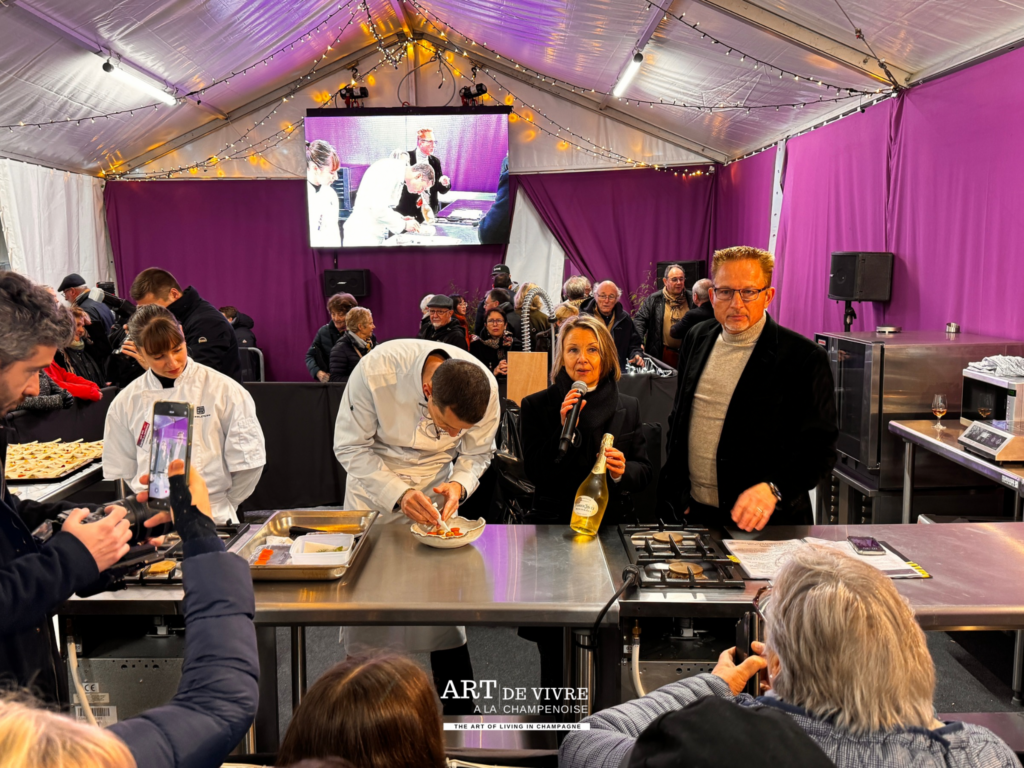
The dinner, devised and prepared by chef Tony Blasco (Tentation Traiteur – Reims), unfolded as a sensitive staging of this living heritage. The evening was punctuated by a performance of Trésors de Champagne by the Pré-Maîtrise of Notre-Dame Cathedral in Reims at the aperitif, then by tableaux blending song and movement, designed under the direction of Ismaël Taggaë (Studio 511).
In echo of this collective momentum, thirty-six Houses, Winegrowers and Cooperatives offered their cuvées to accompany the aperitif and the dishes, inscribing in the glasses the diversity and richness of today’s Champagne.
A Champagne that keeps “digging” its future
Ten years after the UNESCO listing, Champagne does not merely celebrate: it looks ahead.
By supporting research, the sector embarks on a new conquest: that of knowledge, transmission and historical responsibility. Because preserving the cellars means preserving the underground and intimate part of our identity.
Champagne thus moves towards the future, faithful to its history, aware of its singularity, and driven by the desire to pass on.
Séverine Couvreur also wished to salute the commitment of the whole Mission, the companies, the local authorities and partner organisations, the volunteers and the profession, recalling that all of them, through their action, are the true ambassadors of Champagne.
More information
https://www.champagne-patrimoinemondial.org
Photo credits: header photo / Michel Jolyot
Discover all the photos of the evening