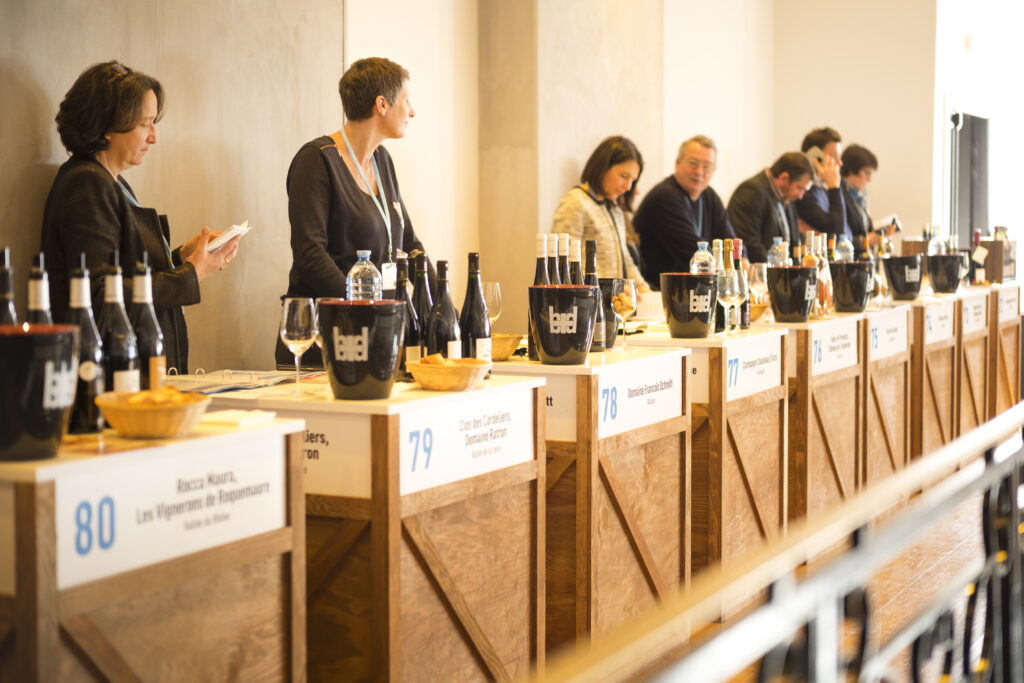

At a meeting with its local restaurateur and wine-merchant partners, Champagne Gosset shared its first impressions of the 2026 harvest. After the racking of the wines, Odilon de Varine puts forward a comparison as rare as it is promising: “It looks like the 1959 vintage.”
The timing had something symbolic. On Monday 7 September 2026, as Maison Gosset was welcoming several of its restaurateur and wine-merchant partners from the region, the wines from the harvest had also just been racked. An important first stage, carried out under the responsibility of Pierre de Caffarelli, Head of Oenology, which makes it possible to begin to better define the profile of the year.
A few weeks earlier, Odilon de Varine, managing director and cellar master of Champagne Gosset, described this harvest in three words: “unusual, interesting and promising”. He did, however, urge caution, as the fermentations were then not completely finished. The racking now provides new reference points.
And one of them particularly catches the attention: “It looks like the 1959 vintage”, confides Odilon de Varine.


The echo of 1959
Comparing a nascent harvest to 1959 is no trivial matter. This reference points to a year that remains in Champagne memory for the ripeness of its grapes and the personality of its wines. It is of course not a matter of announcing, at this stage, an equivalent vintage. The 2026 wines are still at the beginning of their journey and will have to confirm their qualities over tastings, blends and time.
The comparison nevertheless gives a first indication of the nature of the wines observed after racking. The 2026 harvest had stood out for its earliness, but also for a very rapid progression of ripeness. From the end of July and the beginning of August, some grapes had gained up to three degrees in a week.
The musts brought in at Gosset thus showed potential alcohol levels between 10.5 and 14. Behind this range, however, the House had noted a relative homogeneity of acidity. The heatwave episodes had encouraged a degradation of acids in the berries over a large part of the vineyard, drawing balances very different from those encountered in a classic year.
Preserving the Gosset style
For the House, the stakes go beyond the quality of the harvest alone. It is above all about preserving an identity built over time. Gosset stands out notably for the absence of malolactic fermentation, a choice intended to preserve the freshness, tension and ageing capacity of its wines.
Yet some 2026 juices, marked by high levels and lower acidity, could hardly enter the usual blends without altering this balance. From the first analyses, lots were therefore isolated in small vats of 20, 40 or 60 hectolitres.
“The idea of a brand is the constancy and continuity of taste,” recalls Odilon de Varine. The harvest should therefore not be entirely intended for making sparkling wines. Some wines may join the House’s reserves; others could pave the way for Coteaux Champenois.
No final decision has been made. At Gosset, analyses guide the work, but they never replace the appreciation of the wine. “The ultimate judge is always the tasting,” insists the cellar master.

Possible Coteaux Champenois
The Coteaux Champenois hypothesis finds a particular echo at Gosset. Founded in Aÿ in 1584, long before the rise of sparkling wines, the House originally made still wines. The 2026 harvest could thus reconnect, in a contemporary form, with part of its history.
For Odilon de Varine, however, this is neither a nostalgic return nor a new commercial direction. “It is the wine that decides,” he sums up. Gosset has no vocation to produce Coteaux Champenois every year, but only when nature provides the necessary balances.
The wines selected will need to have enough depth to express themselves without the bubble. For the whites, the fractionation specific to Champagne pressing – with the separation of the cuvée and the taille – could also bring particular purity to the juices.
The ripeness of 2026 therefore opens a field of possibilities, without calling into question the House’s priority: making champagnes true to the Gosset style. Atypical wines could become something else, provided they find their balance and their own expression.
Time for confirmations
The meeting organised with the local restaurateur and wine-merchant partners made it possible to share these first observations closest to the field. Restaurateurs, hoteliers and wine professionals are indeed essential relays for helping people understand a House’s work, explaining winemaking choices and conveying the singularity of a year.
The 2026 harvest has not yet delivered all its answers. The next tastings will make it possible to refine the selection of lots, to imagine their destination and to gauge the relevance of this comparison with 1959.
At Gosset, caution therefore remains the watchword. But when one of the most striking vintages of the 20th century appears from the very first comments after racking, the year certainly deserves to be followed closely.
Practical information
Champagne Gosset
12, rue Godart-Roger
51200 Épernay
www.champagne-gosset.com
Excessive alcohol consumption is dangerous for your health. Drink in moderation.
Art de Vivre à la Champenoise, the no. 1 positive online News & Lifestyle magazine in Champagne

Champagne Gosset FAQ
Why is the 2026 harvest special at Gosset?
It combines high ripeness, a wide range of potential alcohol levels and relatively homogeneous acidity. After racking, its profile reminds Odilon de Varine of that of the 1959 vintage.
Will Gosset produce Coteaux Champenois in 2026?
This possibility is being studied for certain atypical wines that would not match the style of the House’s champagnes. The decision will depend on the next tastings.
What is Pierre de Caffarelli’s role at Gosset?
Pierre de Caffarelli is Head of Oenology. He notably oversees the technical monitoring of the wines and the operations carried out after fermentation.